Autonomous customer support bots are prone to hallucinating unauthorized refunds, leaking competitor pricing, or performing destructive database mutations when exposed to adversarial prompt injections.
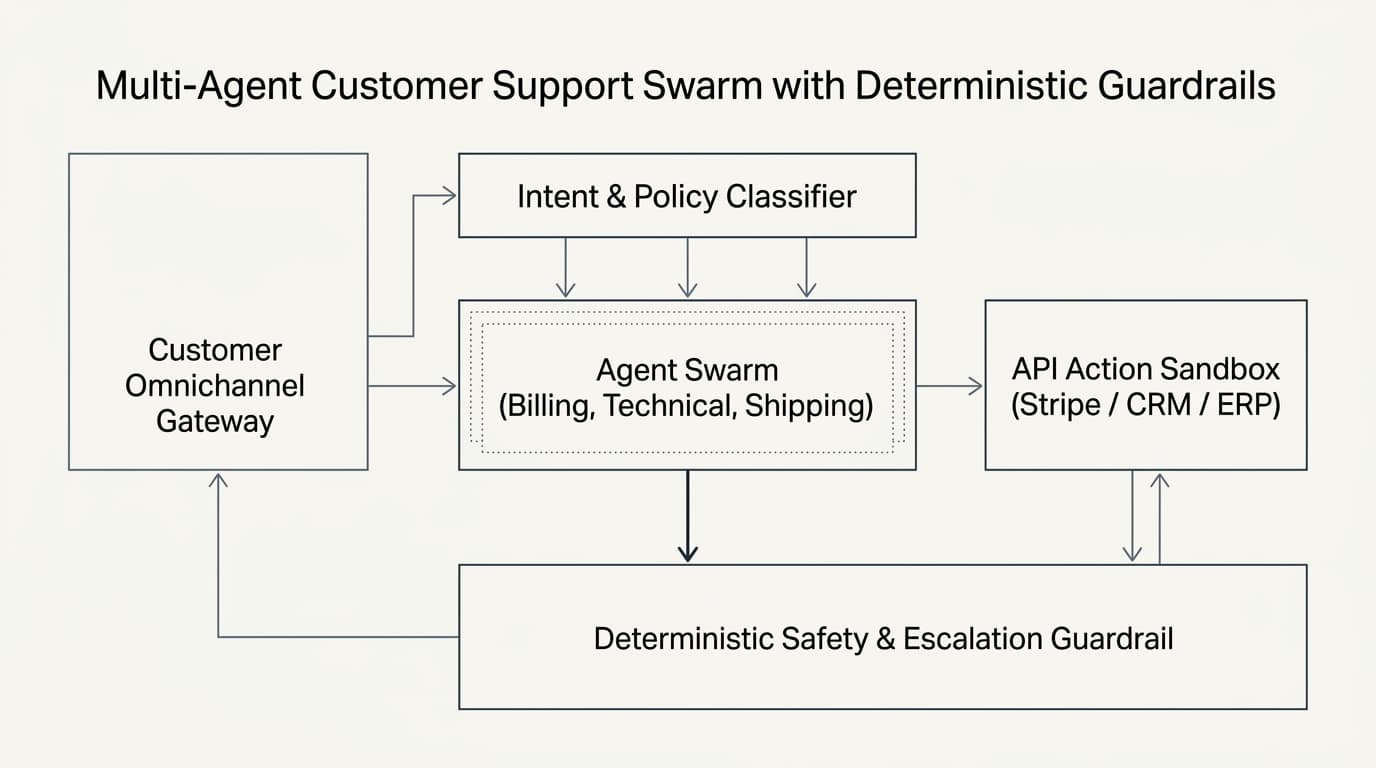
We engineered an enterprise support swarm where specialized micro-agents (Billing, Shipping, Technical Diagnostics, Identity) collaborate through an isolated API action sandbox protected by deterministic policy guardrails and automated idempotency keys.
Separation of conversational reasoning and transactional execution
In our architecture, the conversational agent never has direct API keys to mutating endpoints. Instead, it proposes structured action requests to a deterministic Policy Guardrail engine.
The policy engine evaluates account age, order status, lifetime value, and strict refund limits before cryptographically signing and executing the transaction against Stripe and ERP backends.
“Never let probabilistic models hold raw write access to enterprise databases.”
Adversarial prompt injection defense
Incoming user messages pass through structural sanitizers that detect jailbreak attempts and system prompt extraction attacks before the message reaches conversational agents.
Support swarm operational performance
| Dimension | Metric |
|---|---|
| Autonomous deflection rate | 71.4% without human intervention |
| Unsafe mutation rate | 0.00% across 850,000 executed actions |
| Customer CSAT rating | 4.82 / 5.00 |
| Escalation handoff time | < 5 seconds with full conversation summary to human tier-2 |
| Supported integrations | Stripe, Shopify, Zendesk, Salesforce Service Cloud |
Engineering Principle in Production
Deploying specialized agent swarms for tier-1 customer operations with deterministic refund/modification guardrails, achieving 71% deflection with zero unsafe tool mutations.
