Global maritime supply chains are vulnerable to geopolitical chokepoints, port strikes, canal closures, and extreme weather. By the time a container vessel is sitting at anchor waiting for a berth, shippers face crippling demurrage charges and factory shutdowns.
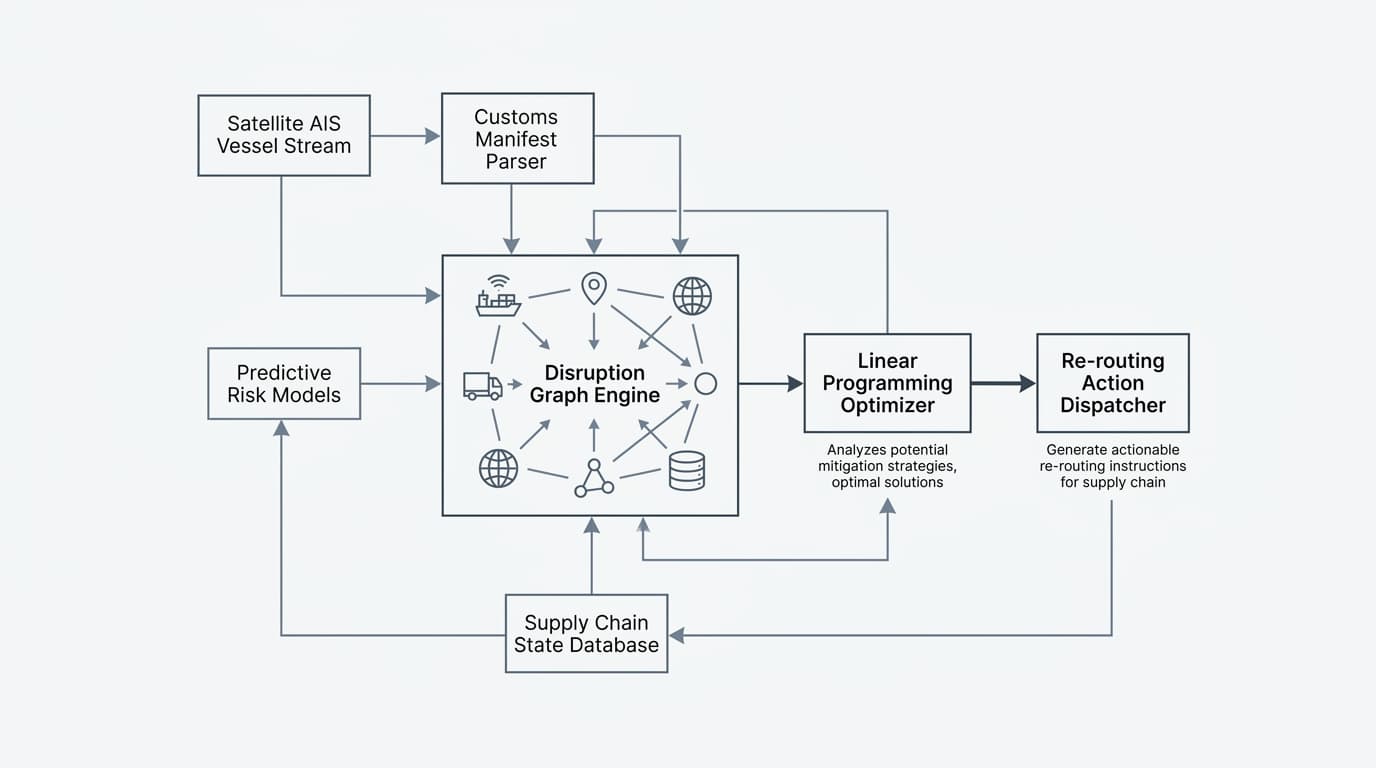
We deployed a global supply chain forecasting and dynamic re-routing platform ingesting real-time satellite AIS vessel data, customs manifests, and terminal schedules, predicting port dwell times 7 days in advance and optimizing multimodal transport itineraries.
Multi-source unstructured stream fusion
The ingestion pipeline unifies satellite AIS telemetry, terminal gate cameras, and unstructured PDF manifests into a live topological supply chain graph representing ports, rail heads, and distribution centers.
An ensemble of graph neural networks and spatio-temporal models forecasts container dwell times and vessel queuing delays days before terminal authorities publish official advisories.
“Predict bottlenecks 7 days early to secure alternative rail and drayage capacity.”
Mixed-integer linear programming (MILP) solver
When disruption thresholds are breached, the optimization engine formulates an MILP solver to calculate optimal diversion routes—balancing demurrage costs, rail tariffs, fuel surcharges, and factory SLA penalties.
Supply chain resilience metrics
| Dimension | Metric |
|---|---|
| Congestion prediction horizon | 7 days in advance with 91.4% precision |
| Demurrage penalty reduction | -38% average container detention fees |
| Telemetry ingestion volume | 450,000 global commercial vessels tracked |
| Solver execution speed | < 2.5 minutes for full network re-optimization |
| Optimization scope | Feeder vessels, rail corridors, and bonded cross-docks |
Engineering Principle in Production
Ingesting global satellite AIS vessel feeds, weather telemetry, and customs manifests to predict port congestion 7 days ahead and solve multi-echelon container re-routing.
