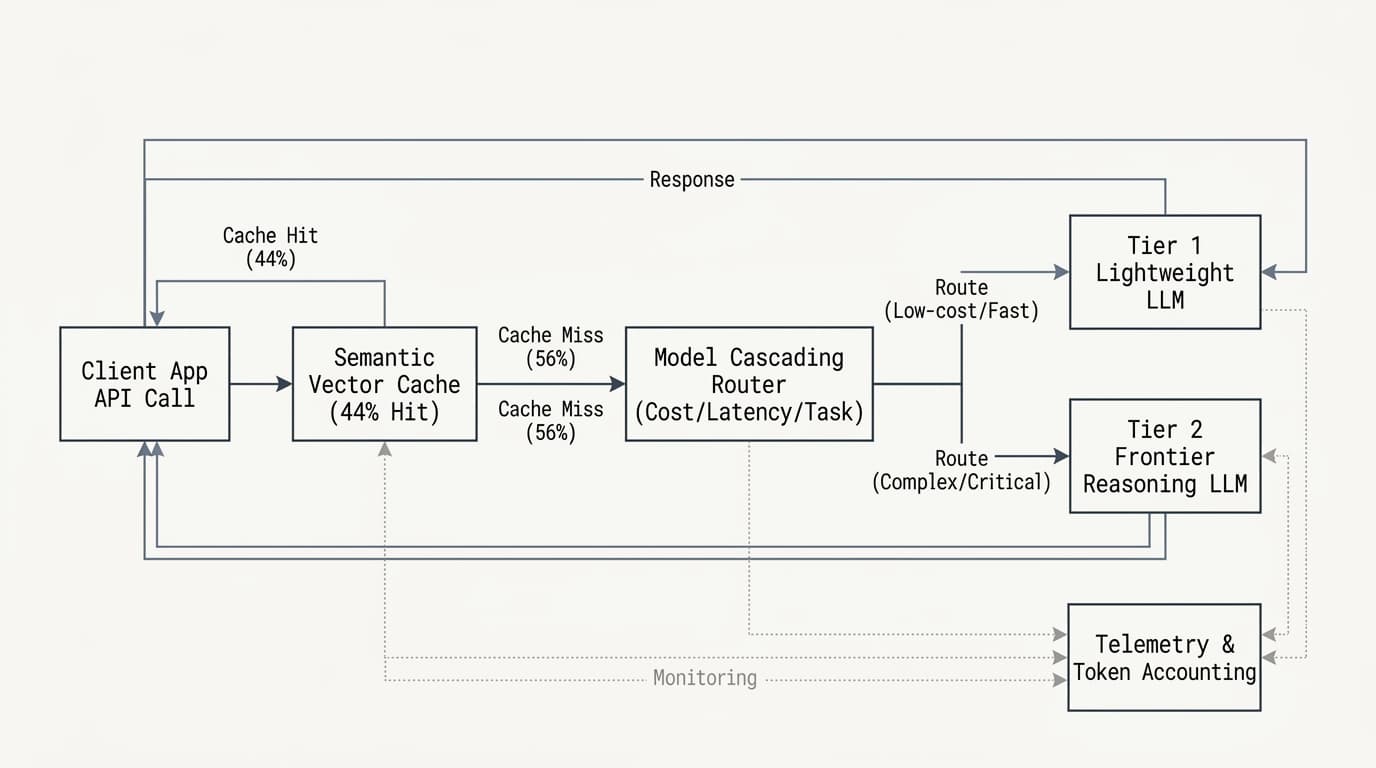
Enterprise AI teams often deploy high-cost frontier reasoning models across their entire product suite. In practice, 60% of user queries are either repetitive or simple enough to be answered by compact, highly optimized models.
We built an intelligent reverse proxy gateway that combines a sub-10ms semantic vector cache with multi-tier model cascading. The gateway dynamically evaluates prompt complexity, routing trivial classifications to micro-models while reserving frontier models for genuine multi-step reasoning.
Vector semantic caching with deterministic invalidation
Exact-match string caching fails because users phrase identical questions differently. Our gateway computes embedding centroids for incoming requests against a Redis vector index with cosine similarity thresholds tuned per use case.
When a semantic cache hit occurs, the response returns in under 12 milliseconds at zero model token cost.
“The fastest and cheapest model call is the one you never have to make.”
Adaptive difficulty cascading
Queries that miss the cache pass through a lightweight classifier. Simple requests are routed to low-cost 8B parameter models; if speculative confidence falls below 0.85, the request transparently escalates to a frontier model with zero user-visible disruption.
FinOps impact and gateway telemetry
| Dimension | Metric |
|---|---|
| Monthly token spend reduction | $190,000 / month saved (-63%) |
| Semantic cache hit rate | 44.2% across customer-facing endpoints |
| Average gateway routing overhead | 8.4 milliseconds |
| Uptime and failover SLA | 99.99% multi-provider automated fallback |
| Cache backend | In-memory Redis Cluster with vector similarity index |
Engineering Principle in Production
Saving $190,000/month in frontier model inference fees using dynamic complexity cascading, Redis-backed vector semantic caching, and sub-10ms routing decisions.
