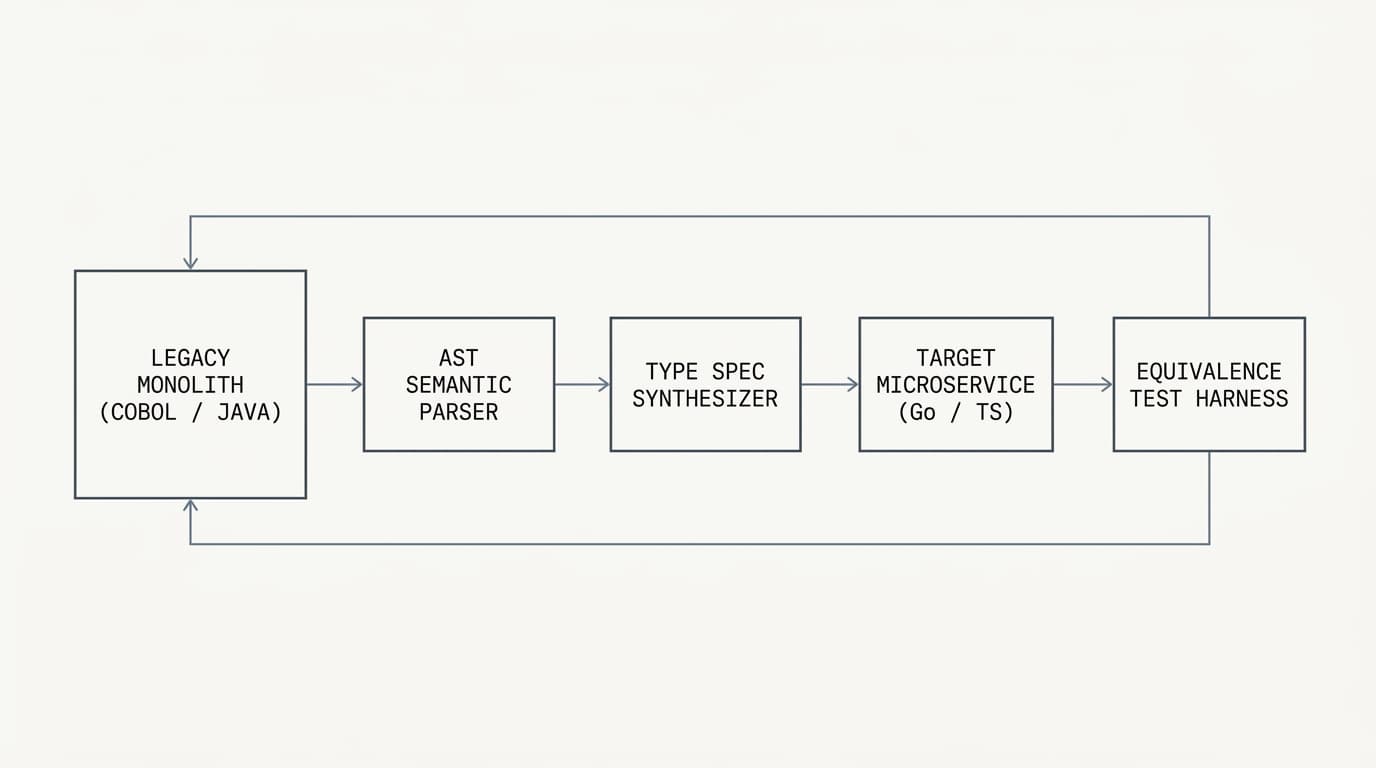
Legacy system modernization is notorious for multi-year timeline slips, budget overruns, and catastrophic logic drift. Rewriting core business logic from scratch usually introduces subtle regression bugs that break transactional guarantees.
We engineered an AST-guided transpilation and test-synthesis pipeline that systematically parsed legacy service graphs, generated idiomatic modern Go microservices, and proved semantic behavioral equivalence using property-based differential fuzzing.
Abstract Syntax Tree extraction vs raw prompt translation
Naive approaches pass legacy code directly to LLM prompts, resulting in subtle numerical precision bugs, hallucinated third-party dependencies, and non-idiomatic code structure.
Our compiler frontend decomposes the legacy AST into deterministic control-flow graphs, data-type contracts, and state mutations. The LLM is used strictly to synthesize idiomatic target functions under strict static compiler type-checking.
“Compiler rigor guarantees structure; LLMs provide idiomatic synthesis.”
Differential fuzzing for zero behavioral drift
Before any generated microservice enters staging, an automated harness executes 500,000 randomized synthetic transactions against both the legacy runtime and the new Go binary, comparing outputs, database writes, and precision down to the penny.
Migration benchmark profile
| Dimension | Metric |
|---|---|
| Codebase scope | 1.8M lines across 42 legacy services |
| Equivalence test pass rate | 100% on 500k synthetic differential runs |
| Migration timeline | 4 months vs original 2-year estimate |
| Compute cost reduction | -74% compute footprint reduction on modern containers |
| Target architecture | Go 1.23 microservices on Kubernetes |
Engineering Principle in Production
Migrating 1.8M lines of monolithic Java and COBOL core banking services to modern Go and TypeScript microservices with automated semantic equivalence verification.
