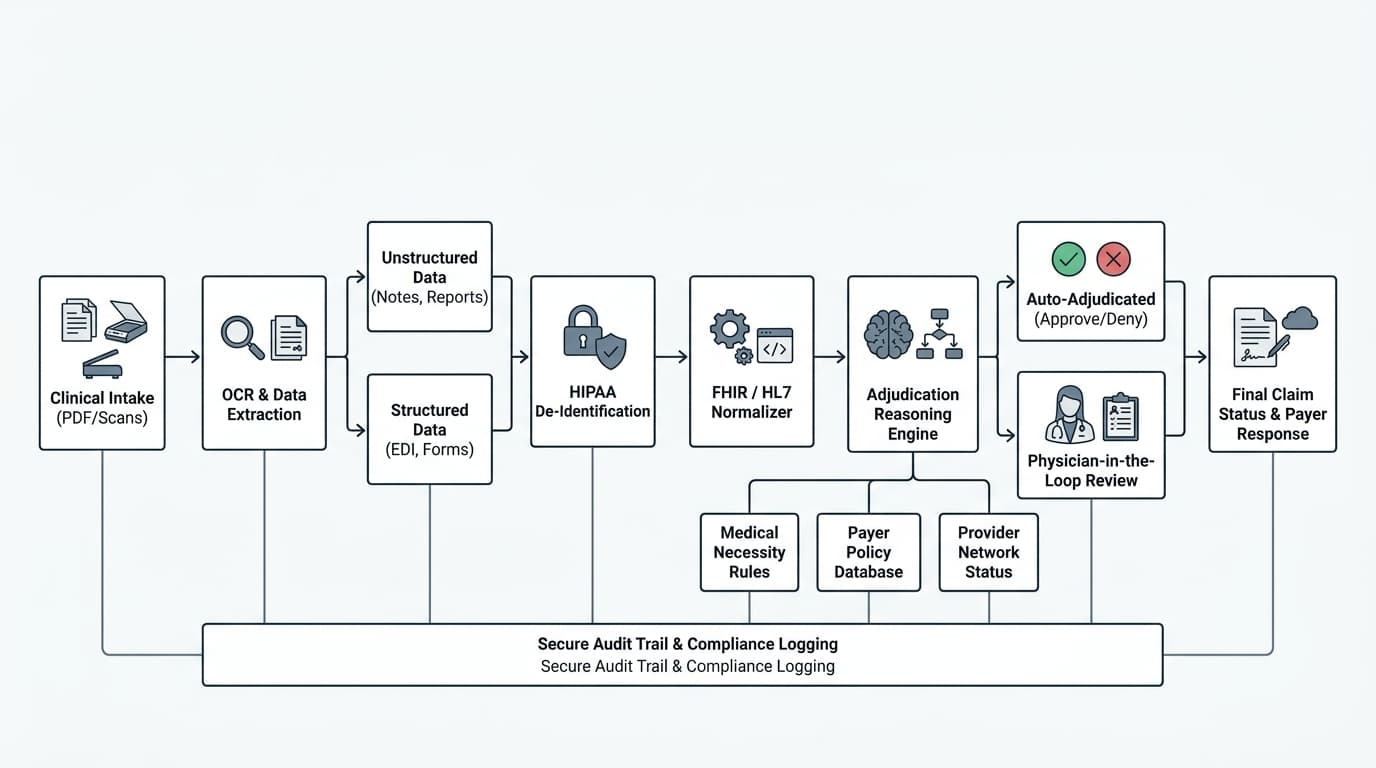
Health insurance claims processing involves thousands of pages of unstructured clinical documentation, doctor notes, lab panels, and prior authorization forms. Manual review backlogs cost payers millions in statutory delay penalties and delay critical patient care.
We architected an on-premise, zero-data-leakage multi-modal clinical intelligence system that processes incoming faxes, scans, and EHR feeds, verifies medical necessity against clinical policy guidelines, and formats claims directly for automated clearinghouses.
Zero-data-leakage on-premises deployment
Under HIPAA and HITECH regulations, Protected Health Information (PHI) cannot traverse third-party multi-tenant API endpoints without stringent Business Associate Agreements and isolated cryptographic envelopes.
We deployed containerized quantized vision-language models directly within the customer's private air-gapped AWS GovCloud VPC, using automated de-identification pipelines before any reasoning layer processes clinical text.
“Absolute cryptographic data privacy is non-negotiable in healthcare workloads.”
Deterministic medical necessity adjudication
Rather than allowing probabilistic models to approve or deny claims directly, the model acts as an evidence extractor: highlighting exact clinical findings, matching CPT/ICD-10 codes, and presenting pre-filled adjudication packages to licensed medical reviewers.
Operational outcomes
| Dimension | Metric |
|---|---|
| Extraction precision | 99.2% on ICD-10 / CPT billing codes |
| Turnaround time | Reduced from 14 days to 4 hours |
| Compliance posture | 100% on-prem VPC / Zero external egress |
| Reviewer throughput | 4.8x increase in claims reviewed per physician-hour |
| Standardization | Native FHIR R4 & HL7 v2 output mapping |
Engineering Principle in Production
Deploying an on-premises HIPAA-compliant multi-modal pipeline that ingests complex clinical records, maps medical codes to FHIR standards, and cuts claims adjudication cycles by 82%.
