Financial fraud moves faster than human review teams. Sophisticated syndicates exploit distributed synthetic identities and rapid multi-merchant transactions that look harmless when examined in isolation.
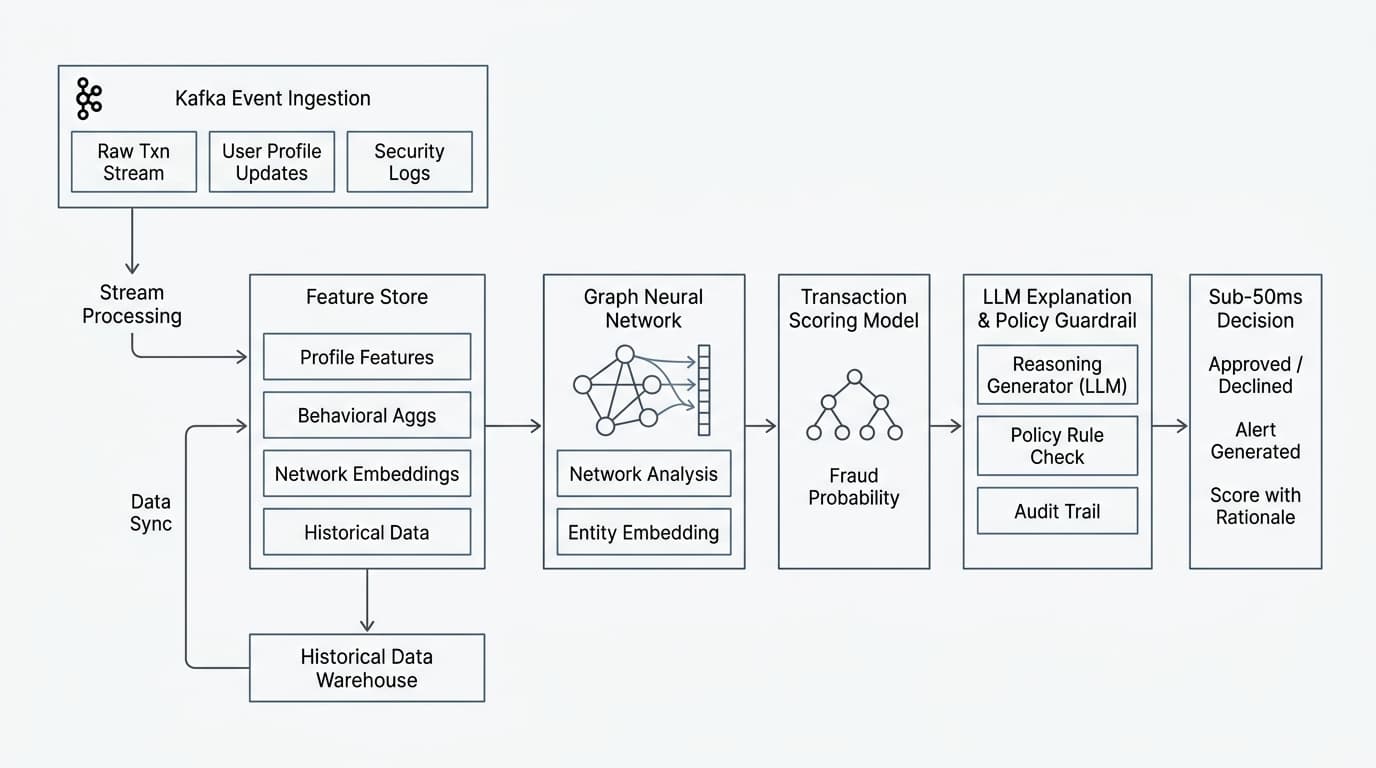
We deployed a sub-50ms transaction fraud scoring engine for a tier-1 fintech processing over 14,500 transactions per second. The system clusters multi-hop entity graphs in memory while generating fully explainable risk justifications required by banking regulators.
The sub-50ms P99 latency budget
In credit card transaction processing, payment gateways impose a hard 75ms timeout before failing open or declining. The machine learning pipeline had an allocated budget of exactly 45ms P99.
We partitioned the inference architecture into two parallel streams: an ultra-fast in-memory Graph Neural Network (GNN) scoring model running in C++ TensorRT, and an asynchronous reasoning loop that enriches high-risk decisions with regulatory-compliant explanations.
“Latency is the primary constraint. Accuracy is useless if the transaction times out.”
Synthetic identity graph detection
By tracking shared device fingerprints, IP subnets, and delivery addresses across seemingly distinct bank accounts, the graph engine uncovers fraud rings that rule-based systems miss entirely.
System telemetry and performance benchmarks
| Dimension | Metric |
|---|---|
| Peak throughput | 14,500 transactions / second |
| P99 Decision latency | 38 milliseconds |
| False positive reduction | -41% compared to legacy heuristics |
| In-memory state cache | Redis cluster with sub-4ms hydration |
| Regulatory auditability | 100% of declined transactions carry signed rationale |
Engineering Principle in Production
A dual-tier streaming architecture combining Kafka/Flink event pipelines, Graph Neural Network subgraph clustering, and an LLM explainability layer operating under a strict 45ms P99 SLA.
