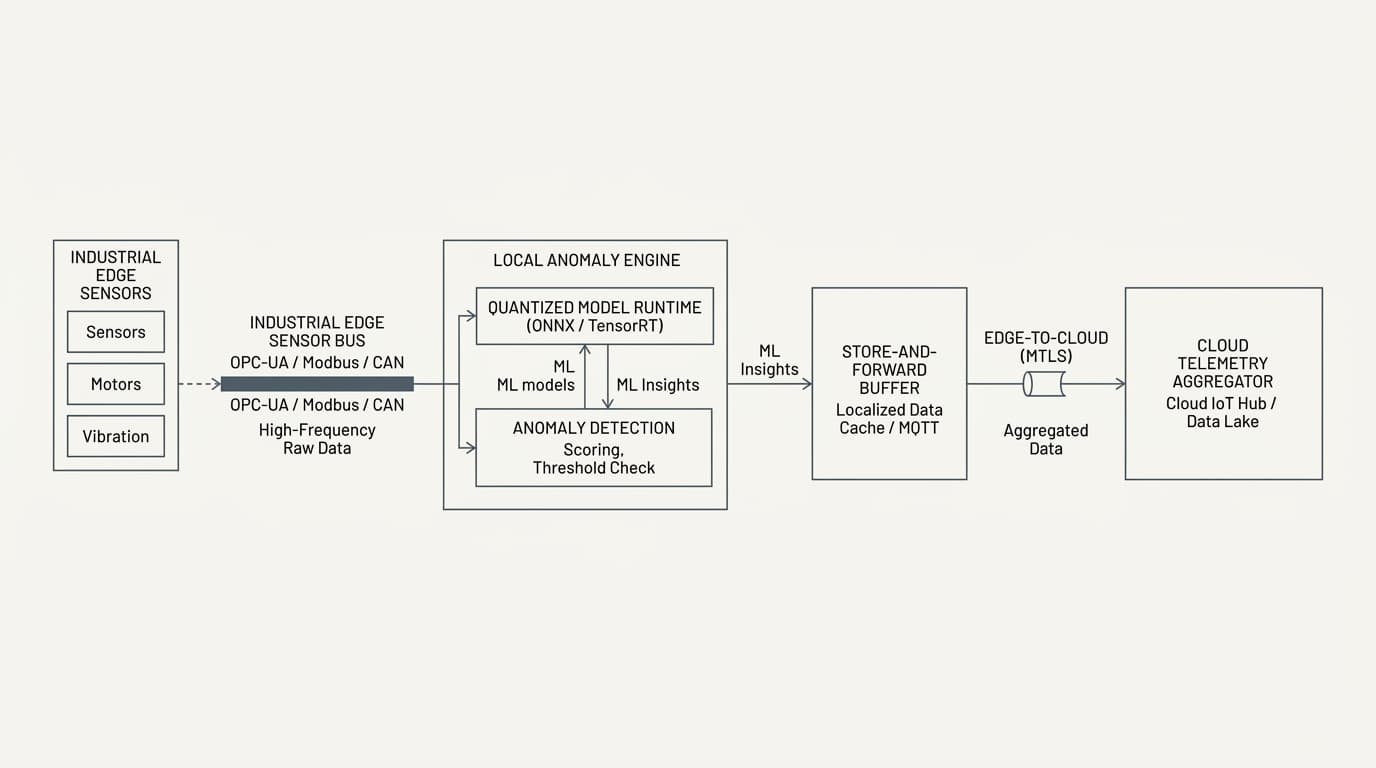
Industrial machinery, maritime vessels, and mining fleets operate in harsh environments with intermittent satellite or cellular connectivity. Streaming raw gigabytes of high-frequency vibrational and thermal sensor telemetry to cloud data centers is cost-prohibitive and impractical.
We engineered an edge-native predictive maintenance architecture running INT8 quantized models directly on ARM and NVIDIA Jetson edge gateways, detecting anomalous thermal and vibrational degradation in real time while operating completely offline.
Model quantization and memory-constrained inference
Edge gateways have strict 15W power envelopes and limited memory. We quantized temporal convolutional neural networks and transformer anomaly detectors down to INT8 using TensorRT and ONNX Runtime, preserving 99.4% of full-precision FP32 accuracy while cutting compute footprint by 75%.
“Offline-first edge intelligence prevents catastrophic mechanical failure before connection drops.”
Store-and-forward synchronization over high-latency links
When connectivity drops, edge nodes maintain localized append-only buffers. Once a telemetry satellite handshake succeeds, nodes transmit compressed anomaly signatures rather than raw waveform streams, reducing cellular bandwidth costs by 94%.
Hardware performance & reliability metrics
| Dimension | Metric |
|---|---|
| Failure prediction lead time | 48 hours advance warning |
| On-device inference latency | 4.6 milliseconds per sensor burst |
| Bandwidth reduction | -94% payload transmission cost |
| Offline buffer capacity | Up to 30 days disconnected continuous operation |
| Hardware target | NVIDIA Jetson Orin Nano & ARM Cortex-A53 |
Engineering Principle in Production
Running quantized 8-bit sensor intelligence models on edge hardware with store-and-forward synchronization, predicting industrial motor and fleet failures 48 hours in advance.
