When critical production outages occur at 3:00 AM, engineering on-call engineers spend precious minutes digging through fragmented Datadog dashboards, Kubernetes event logs, and Slack channels to identify which change broke the system.
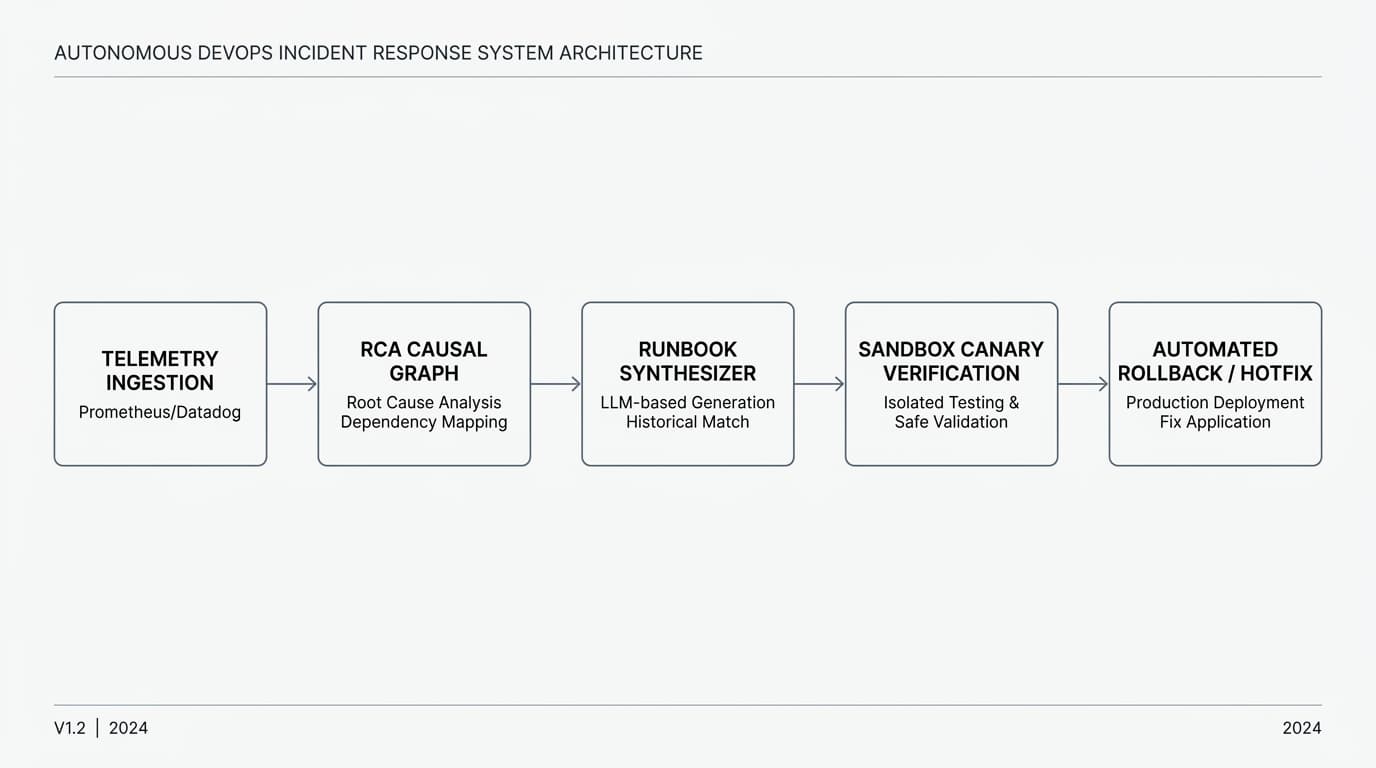
We deployed an autonomous SRE incident copilot that ingests real-time OpenTelemetry streams, constructs causal dependency graphs during degradation events, formulates verified remediation plans, and executes sandboxed canary repairs with human-in-the-loop sign-off.
Causal graph inference over high-cardinality metrics
Alerts rarely arrive in isolation; a cascading database connection pool exhaustion triggers HTTP 504 errors across dozens of downstream microservices.
The agent correlates metrics, trace IDs, and recent deployment commits into a dynamic DAG, identifying the exact root cause in under 45 seconds rather than relying on on-call engineers to reconstruct timelines manually.
“Isolate the root cause before human engineers even finish joining the incident bridge.”
Sandboxed canary rollback verification
The remediation engine simulates the mitigation in an isolated staging environment or executes a progressive 1% traffic canary before executing a full cluster rollback, preventing destructive remediation loops.
Incident management benchmarks
| Dimension | Metric |
|---|---|
| Mean Time to Detect (MTTD) | 38 seconds |
| Mean Time to Resolve (MTTR) | Reduced from 42 mins to 11 mins (-74%) |
| False alarm suppression | 88% noise reduction in PagerDuty queues |
| Safety guardrail | Mandatory human approval for database & infrastructure mutations |
| Telemetry inputs | OpenTelemetry traces, Prometheus metrics, Kubernetes logs |
Engineering Principle in Production
Cutting Mean Time to Resolution (MTTR) by 74% using an observability agent swarm that correlates multi-service telemetry, isolates root causes, and validates canary rollbacks.
