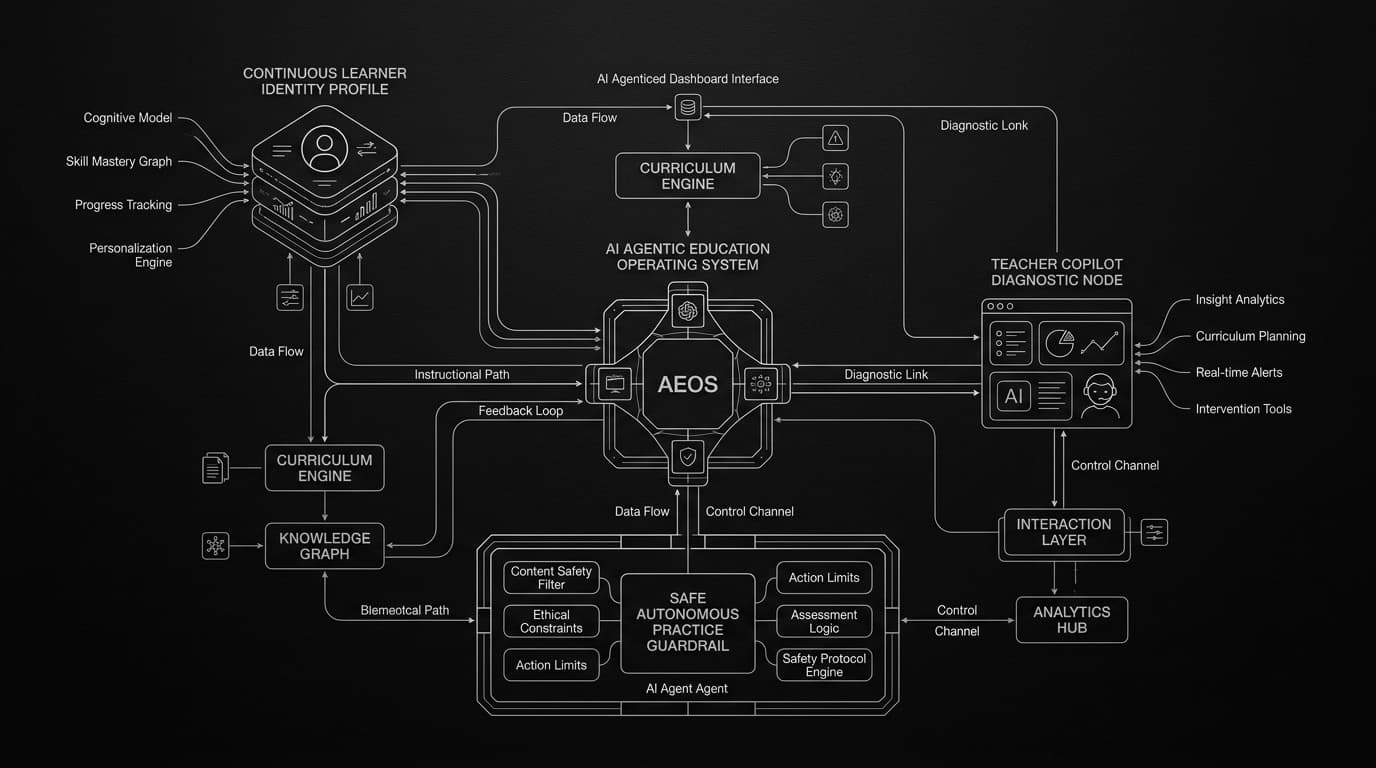
The product already worked. Students learned through live 1:1 classes with human teachers. The problem was that the quality of the experience depended heavily on which teacher a student happened to get, how much time that teacher had, and how consistently progress was tracked outside the classroom.
The opportunity was not to replace the teacher. It was to build enough intelligence around the teacher that the system could enforce a quality floor while the teacher continued to set the ceiling.
Digital learning identity first
The foundational breakthrough was establishing a continuous digital learning identity: a living graph tracking diagnostic history, mastery vectors across 30+ capabilities, recurring misconceptions, and learning pace.
Without this ground truth layer, every AI feature operates in a vacuum. With it, homework diagnosis feeds directly into pre-class briefings and adjusts tomorrow's practice difficulty.
Teacher copilot & earned autonomy
Teachers were spending 45 minutes before each session reviewing homework and drafting lesson agendas. Our copilot analyzes submitted student work, flags the exact step where sign flips or conceptual errors occurred, and drafts a 2-minute insight briefing.
“The model sets the floor. The teacher still sets the ceiling.”
Evaluation harnesses before autonomous tutoring
Autonomous 24/7 tutoring was bounded by strict evaluation harnesses. The model guides students Socratically rather than revealing solutions, and immediately escalates ambiguous queries back to the human educator.
Architecture metrics
| Dimension | Metric |
|---|---|
| Learner journey scope | 9 distinct journey stages |
| Capabilities mapped | 30+ individual agentic capabilities |
| Teacher prep reduction | -35 minutes per session |
| Mastery tracking | Continuous probabilistic graph update |
| Escalation policy | Deterministic teacher handoff on boundary misses |
Engineering Principle in Production
How we designed an AI-assisted learning architecture across diagnostics, planning, tutoring, mastery tracking, and parent communication covering 9 learner-journey stages and 30+ capabilities.